The case for choosing European.
Sodium sulphate is sold as a commodity — but its industrial value depends entirely on what is, and is not, inside the bag. European producers focus on what matters: composition, consistency and the certainty of supply.
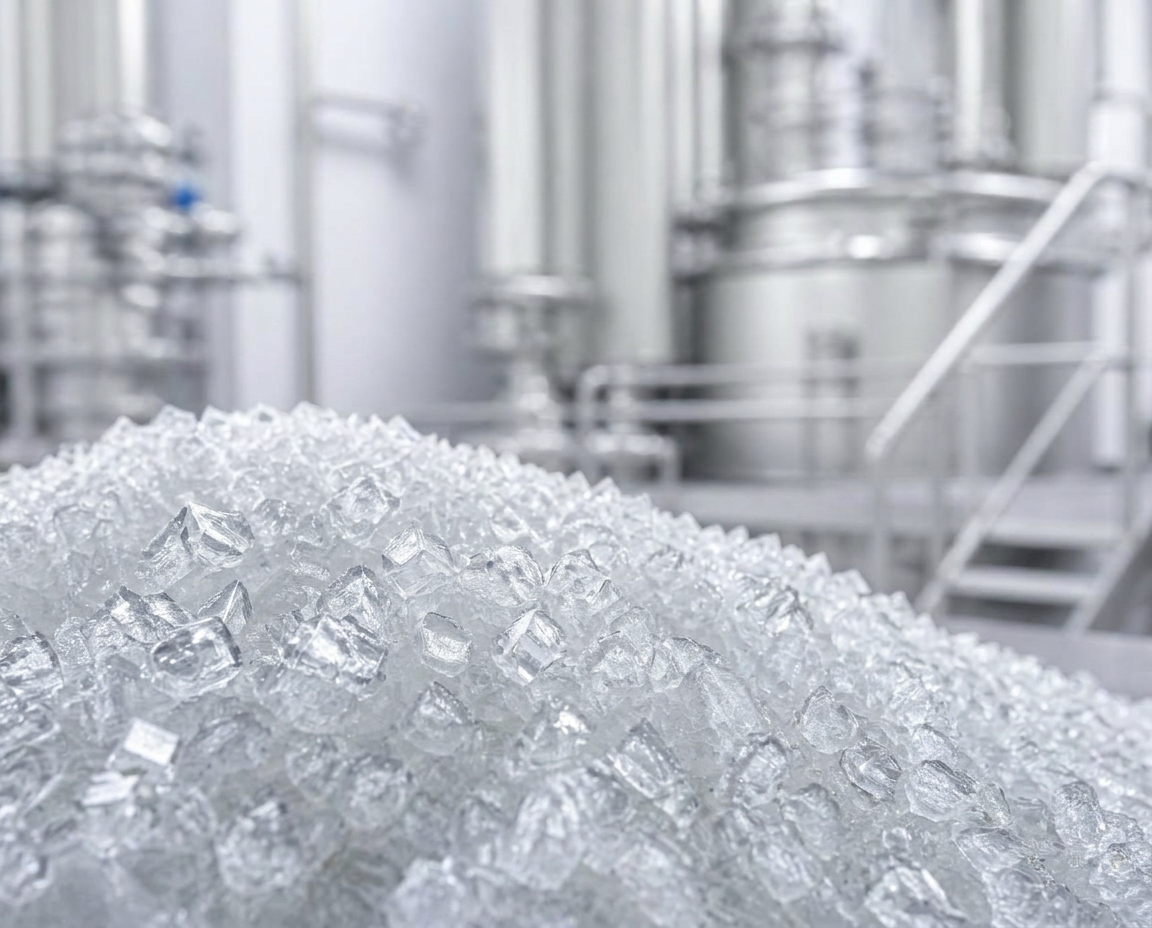
European production, in a snapshot.
Natural sources account for just below 60% of European output — concentrated in Spain and Turkey, where rich mineral deposits are extracted by mining, evaporation and crystallisation. The remainder is recovered as co-product, principally from viscose fibre manufacture.
- 60%
- Natural
- 22%
- Viscose co-product
- 18%
- Other industrial
What "European quality" means in practice.
Purity that holds up
European production routes — natural extraction and quality-controlled co-production — yield exceptionally high Na₂SO₄ content with tightly bounded impurities. Formulations behave the way they should, batch after batch.
Consistency over time
Predictable composition is what allows detergent and glass manufacturers to lock in process parameters with confidence. European producers deliver to written specifications that are stable, or change slowly and deliberately.
Reliable, local supply
Production in Europe means short delivery distances, low transport CO₂ and flexibility on volumes — a different equation from long distance imports.
Responsible production
SSPA members operate to high European environmental and safety standards, with continuous investment in efficient processes and circular co-production.
The numbers behind the promise.
Indicative ranges across SSPA members' product portfolios. Individual grades vary by intended use and source — exact specifications are agreed between supplier and customer.
- Na₂SO₄ content
- 97.5 – 99.9%
- Water content (max.)
- 0.05 – 0.3%
- NaCl (max.)
- 0.008 – 2.5%
- Calcium (max.)
- 2 – 300 mg/kg
- Magnesium (max.)
- 0.3 – 500 mg/kg
- Iron (max.)
- 2 – 100 mg/kg
- Insolubles (max.)
- 0.002 – 0.1%
- pH (1% solution)
- 5.5 – 9.5
- Bulk density
- 1.15 – 1.65 kg/dm³